
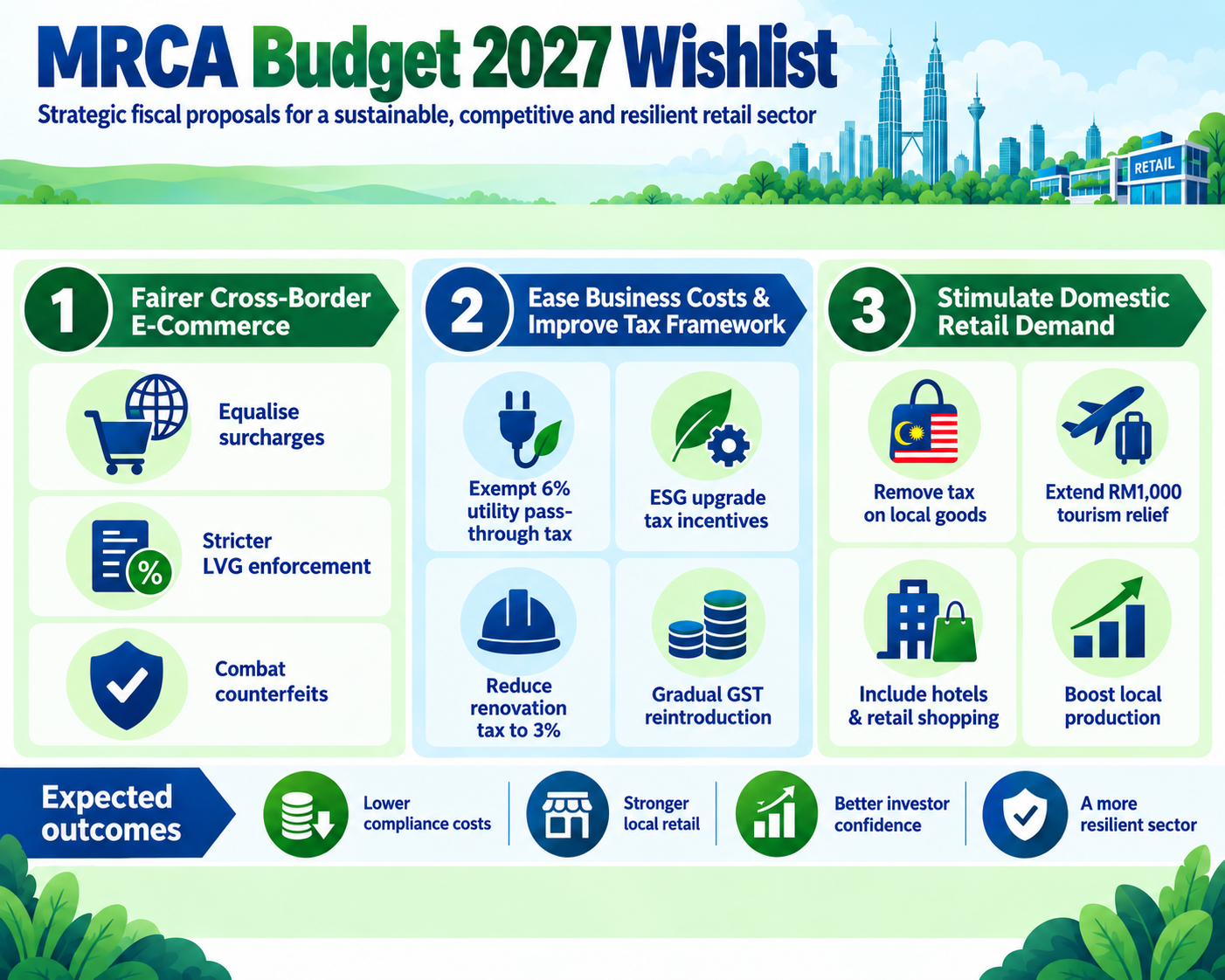
KUALA LUMPUR, 14 September 2026 — As Malaysia prepares for the tabling of Budget 2027 by Prime Minister and Finance Minister YAB Dato’ Seri Anwar Ibrahim on 9 October 2026, the Malaysia Retail Chain Association (MRCA) has outlined a strategic fiscal wishlist to foster a sustainable, competitive, and resilient retail sector.
Malaysian businesses are navigating an increasingly complex environment, contending with compounding operational costs and external competition. To drive productivity and job creation, the MRCA emphasises the critical need for policy consistency, regulatory clarity, and equitable economic frameworks.
The MRCA urges the Ministry of Finance to incorporate the following macroeconomic solutions into the drafting of Budget 2027:
1. Ensure Equitable Compliance For Cross-Border E-Commerce Platforms
Local brick-and-mortar retailers continue to face substantial compliance disparities compared to untaxed or under-taxed foreign e-commerce platforms offering ultra-low prices. This structural imbalance not only threatens local enterprises but results in significant tax base erosion for the nation.
Equalising Surcharges & LVG Enforcement: We strongly urge the Government to secure national revenue by implementing stricter policies and equalising surcharges on cross-border e-commerce transactions, including the stricter enforcement of the Sales Tax on Low-Value Goods (LVG).
Combatting Counterfeits: We call for stringent regulatory controls to mitigate the proliferation of counterfeit and inferior goods on e-commerce platforms, thereby protecting consumer safety, preserving quality standards, and defending the intellectual property of legitimate brand owners.
2. Optimise Taxation To Alleviate Operational Burdens & Incentivise ESG Upgrades
The MRCA is deeply concerned by the escalating tax burden on commercial operations, particularly regarding the taxation of pure operational reimbursements.
Utility Pass-Through SST Exemption: We urgently request the Government to exempt the 6% Service Tax on utility supplies for commercial tenants paying via mall management, which took effect on 1 July 2026. Taxing these pure pass-through reimbursements creates an inequitable double-taxation effect, necessitating a regulatory fix to prevent cascading operational costs.
Tax Rebates for ESG Operational Upgrades: We propose targeted tax rebates or double tax deductions for commercial stakeholders investing in ESG operational upgrades, particularly regarding facility governance and public safety. Incentivising capital expenditures for active fire safety and modernised infrastructure.
Renovation Service Tax Reduction: Additionally, we maintain our proposal to reduce the Service Tax on construction and renovation services to 3%, as building materials are already subject to tax.
Phased Reintroduction of GST: We urge the Ministry of Finance to reintroduce the Goods and Services Tax (GST) utilising a staggered, step-up structure. Starting from an accessible, low base and progressively adjusting upward over five-year intervals will grant businesses adequate gestation to adapt, cushion household sentiment, and safeguard economic stability. A transparent, multi-stage consumption tax with a reliable refund mechanism and strict zero-rating for essential goods will eliminate the compounding costs of SST, broaden the national revenue base, and establish a fairer tax ecosystem for businesses and consumers alike.
3. Stimulate the Domestic Retail Economy via Targeted Tax Reliefs and Local Product Incentives
Enhance Domestic Retail Competitiveness: We advocate for the elimination of sales taxes on locally manufactured goods. Removing these cascading costs will allow domestic retailers to maintain highly competitive pricing against foreign imports, thereby stimulating local production and consumption.
Expand Tourism Tax Relief: We urge the Government to extend the RM1,000 domestic tourism tax relief through 2027 and expand its scope. Rather than limiting it to specific sectors, the relief should explicitly include hotel accommodations and targeted retail shopping expenditures to maximise the economic multiplier effect of domestic tourism.
The MRCA believes that a stable and business friendly policy framework will reduce compliance costs and improve investor confidence. We remain committed to working closely with the Government, providing actionable industry insights to shape a Budget 2027 that supports a globally competitive and sustainable Malaysian retail sector.